Friday, January 25, 2013

Tuesday, January 8, 2013

Westward, and Into Legend...


In 1937, director John Ford bought the rights to a short story he'd read in the April issue of Collier's magazine, "Stage to Lordsburg"; two years later, his film translation -- 1939's Stagecoach -- would make movie history.

Prior to the success of Stagecoach, Hollywood thought of the Western as B-grade movie material, at best, and unlikely to be big box office.

When John Ford began his search for a producer, the whole project was viewed with skepticism by producers like David O. Selznick (who was busy with pre-production on another large budget picture, Gone With the Wind), and the director's insistence on the use of a no-name actor like John Wayne for one of the key roles was thought far too risky for any real investment.


John Wayne, in a publicity still for The Big Trail (1930)


John Wayne had been at the studio since the silent days, starting while a student on football scholarship at the University of Southern California; legend has it Tom Mix found him work as a prop man in return for football tickets. (Wayne, a 6'4" tackle, lost his scholarship after a surfing injury and never graduated.)

Wayne (who started out acting under his real name, Marion Morrison, or as "Duke Morrison"), was soon finding bit parts in movies, many with John Ford, who felt the young actor had a great future ahead of him.

But prior to Stagecoach, Wayne was still struggling  -- mostly working for low-budget studios known collectively as "Poverty Row" --and the only big-budget Western that he had starred in (1930's The Big Trail) had been financially unsuccessful.


(It was Ford who got John Wayne that role in The Big Trail; he recommended Wayne to director Raoul Walsh. And it was Walsh who furnished Marion Morrison with a new stage name. He first suggested 'Anthony Wayne,' after a Revolutionary War hero. When the studio thought that sounded "too Italian," he countered with 'John' as a perfectly all-American second choice.  John Wayne had had the nickname "Duke" since childhood; his constant companion growing up was an Airedale named Duke, and the family took to calling the boy "little Duke.")


Wayne (left) and John Ford (in background, left)
on the set of Stagecoach


The track record of the director himself proved to be another problem. Ford had followed his brother, vaudevillian-turned- film director Francis Ford, to Hollywood, making his directorial debut in either 1914 or 1917 (accounts vary), and by 1927, had some 80+ films under his belt.

Though he had turned out an impressive array, some of which had been very successful (including 1927's The Iron Horse), there was some question as to whether he could turn his enthusiasm for his newest pet project into  box-office gold.


Claire Trevor and John Wayne in Stagecoach still


When Ford finally secured a producer, Wally Wanger, he was offered little more than half the budget he had asked for -- mainly because of his refusal to replace John Wayne with Gary Cooper. Ford's concession to secure the backing was to give actress Claire Trevor top billing; at the time, she had more name recognition than any of the other actors, thanks to a series of lead roles in movies opposite names like Edward G. Robinson, Humphrey Bogart and Spencer Tracy.


John Ford, at John Ford's Point in Monument Valley
Stagecoach marked John Ford's first foray into Utah's Monument Valley, a five-mile wide expanse of flat red silt, punctuated by buttes and tall mesas, which became his favorite place to film, owing both to the remoteness of the locale (Ford despised studio oversight) and its iconic and desolate look. One particular area and vantage point, used in The Seachers (1956), was named in honor of the director and has become a popular tourist destination.


John Ford would later say he was particularly attracted to Stagecoach "because there's not a single respectable character in the cast."


Preparing for a scene on the set of Stagecoach
Thanks to several story changes suggested by famed Chicago reporter-turned-screenwriter Ben Hecht (made during a weekend trip on Ford's yacht at Catalina Island) -- the Ringo Kid is a fugitive; his love interest is a 'saloon girl'; and other travelers include an alcoholic doctor, a pregnant society belle, a whiskey salesman, and a larcenous banker.

"It violates all the censorial canons," said Stagecoach screenwriter Dudley Nichols.


(Much later, when Hecht saw the finished movie, he remarked to Ford that is was a great story, though somewhat familiar. "I really like it."

"You ought to," Ford replied. "You wrote it.")


Though it failed to win Best Director of Best Picture (losing out to Gone with the Wind)Stagecoach catapulted John Ford into the top tier of directors, and leading man John Wayne onto the A-list. Wayne and Ford would go on to team up many times; their fifty-year collaboration yielded some two dozen films, among them such classics as She Wore a Yellow Ribbon (1949), Rio Grande (1950), The Quiet Man (1952)The Searchers (1956), and The Man Who Shot Liberty Valance (1962).


Stagecoach would also prove to be a landmark in the career of a trail-blazing, champion rodeo rider-actor-stuntman named Enos Edward "Yakima" Canutt.

Like Wayne, Canutt is alleged to have gotten his start in films thanks to movie cowboy Tom Mix.


In this and future movies with John Wayne, Canutt worked out techniques for realistic screen fighting scenes that are still used today. He also went on to develop safety devices and special rigging for use by stuntmen.


It was Yakima Canutt who performed the most talked about stuntwork in the film.

Canutt would later replicate and improve upon his signature stunt -- dropping between a team of racing horses and sliding to the rear of the stagecoach -- in 1938's Zorro's Fighting Legion, adding in a backflip and a climb onto the back of the stagecoach.


(This stunt would be performed again -- as an homage to Canutt -- in a little known film called Raiders of the Lost Ark.)

Canutt's stunt in Stagecoach is consistently cited as either the best or second-best movie stunt of all time (behind Buster Keaton's falling house in Steamboat Bill, Jr.). Another piece of stuntwork considered the best of all time: the chariot race in Ben Hur, coordinated by Yakima, with his son Joe doubling for Charlton Heston. )


His career as a stunt coordinator continued into the 1970s; Canutt earned an Honorary Oscar for his work, as well as induction into rodeo and stuntwork Halls of Fame.


Stagecoach, a story of corruption and redemption, was destined to become a classic. Its sweeping landscapes, skilled use of foreshadowing, dramatic lighting and camera angles, and dependence on plot rather than action set a new standard for Westerns and influenced future directors and actors.


Orson Welles is said to have watched the movie dozens of times before filming Citizen Kane, calling it "my textbook...John Ford was my teacher." And when asked which directors he most admired, Welles replied, "The old masters. By which I mean, John Ford, John Ford, and John Ford."


"So they tell me you want to be a picture maker. What do you know about art?...When you’re able to distinguish the art of the horizon at the bottom of a frame, or at the top of the frame -- but not going right through the center of the frame -- when you’re able to appreciate why it’s at the top and why it’s at the bottom, you might make a pretty good picture-maker. Now, get out of here."

-- John Ford, to 15-year-old Stephen Spielberg


Join the Conyers-Rockdale Library this month as we celebrate the Western.
The Westerns display -- featuring Stagecoach, along with other Western DVDs, audiobooks and books -- is located adjacent to the New Books section.


Wednesday, December 19, 2012

Chaplin's Early Years


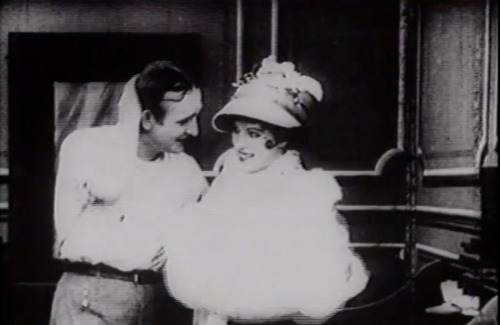
Most, if not all, comic actors have donned skirts in the name of a laugh at some point in their career. So it's not surprising to find a young Charlie Chaplin taking to lipstick and a wig from time to time. In The Masquerader, Chaplin uses his "feminine wiles" to regain entry into Mack Sennett's Keystone Studios, from which he had (in the film) been fired a short time earlier.


Chaplin spies on fellow Keystoner Roscoe Arbuckle in The Masquerader

1912 Portland, Oregon vaudeville ad


In real life, Keystone Studios had lured Chaplin from Fred Karno's London Company, a British traveling vaudeville show where he had gained notoriety for his portrayal of a drunken audience member who interferes with the stage show in a sketch called "A Night at an English Music Hall." (Chaplin would later use this idea for a 1915 short film for Essanay Company, A Night at the Show.)


Publicity photo of "A Night in an English Music Hall"


Charlie Chaplin in 1914


It was for his second short film at Keystone, Mabel's Strange Predicament, that Charlie Chaplin hit upon the character for which he would become renowned. "I had no idea what makeup to put on," he recalled in his autobiography. "However, on the way to the wardrobe I thought I would dress in baggy pants, big shoes, a cane, and a derby hat....remembering Sennett had expected me to be a much older man, I added a small moustache, which, I reasoned, would add age without hiding my expression. I had no idea of the character. But the moment I was dressed, the clothes and the make-up made me feel the person he was. I began to know him, and by the time I walked on to the stage he was fully born."


A Tramp is born: Mabel's Strange Predicament
(Mabel Normand, Charlie Chaplin, Marie Dressler and
officer Wallace MacDonald, in Tillie's Punctured Romance
Charlie Chaplin would go on to make at least 33 more short films (or "two-reelers," as they were known) during his year at Keystone, before accepting a higher-paying contract from Essanay Company. During that year, he played a variety of characters, from a boxing referee (The Knockout) to a baker (Dough and Dynamite), and participated in cinematic history by portraying a villainous con artist in the first full-length comedy ever filmed, Tillie's Punctured Romance.


Officer Charlie reports for duty in A Thief Catcher
In 2010, a long-lost and forgotten two-reeler surfaced at a Michigan antique sale, at last providing definitive proof of something Chaplin had many times claimed: that during his tenure with Mack Sennett, he also played a Keystone Kop.


Two DVD sets in the library collection -- Chaplin's Essanay Comedies and The Chaplin Mutuals -- provide a look at Chaplin's growth from vaudevillian to celebrated master of the comedic screen.

(A third, Chaplin at Keystone, soon to arrive, features those first and earliest days spent with Mack Sennett at Keystone Studios.)

These and other silent classics are now available at the Conyers-Rockdale Library. Check one out today, and see history in the making.

The Little Tramp annoys a "documentary film crew" in Kid Auto Races at Venice


Monday, December 17, 2012

Douglas Fairbanks: Film's First Superhero

He was a founding member of the Academy of Motion Picture Arts and Sciences and its first President.

Superman's physical appearance was modeled on his all-American looks and athletic build.

He co-founded United Artists with Mary Pickford, Charlie Chaplin and D. W. Griffith.

He created the very first film school, at the University of Southern California.

In 1929, he co-hosted the very first Academy Awards.

His portrayal of Zorro directly inspired Bob Kane's creation, Batman.

His 1938 donation of film and memorabilia formed a cornerstone for the Museum of Modern Art collections.

And he was one of the first to embrace both the use of original musical scores for movies and a new innovation called Technicolor (his The Black Pirate was the third movie to be filmed entirely in Technicolor, which was at that time an expensive, time-consuming headache of trial-and-error).


Jean Dujardin in The Artist

(He also served as inspiration for the look of "George Valentin" in the modern-day silent movie, The Artist (which included an actual clip from Fairbanks' film, The Mark of Zorro). The film's star, French actor Jean Dujardin gave a shout-out to Fairbanks in his acceptance speech at the 2012 Academy Awards after winning the Oscar for "Best Leading Actor".)


Fairbanks, in 1915's The Lamb

Born Douglas Elton Thomas Ullman, he became Douglas Fairbanks when -- after her divorce from third husband Charles Ullman -- Douglas' mother Ella readopted the surname of her first husband, John Fairbanks. Douglas showed an early proclivity for both the stage and athletics, acting in local theater around Colorado. After school, he made his way to New York and by age 19, he was performing on Broadway, becoming well-known for his acrobatic as well as his dramatic flair.


Fairbanks clowning around with wife Mary Pickford
and best friend Charlie Chaplin


In 1915, he signed his first movie contract, appearing the same year in his first film, The Lamb, directed by D. W. Griffith, and within three years, he would be Hollywood's most popular actor, portraying a series of adventurers and swashbucklers like Zorro, Robin Hood, and D'Artagnan.

He also became known as a proponent of healthy and moral living, penning a series of writings in which he advised his readers that "fresh air and regular daily exercise are absolute necessities" and to "resist everything that tends to make you soft and satisfied...keep in motion and do not accept the benfits of civilization too easily."

"Happiness," he wrote in Laugh and Live, "is findamentally a state of mind, not a state of body...start the morning off with a laugh and you needn't worry about the rest of the day."


Fairbanks holds Chaplin aloft at a
1918 Liberty Bond rally in NYC


Even scandal could not shake the public's love for Fairbanks. In 1918, Fairbanks and actress Mary Pickford (known as "America's Sweetheart" for her many roles as the charming naif) began an affair while on tour to promote the sale of Liberty Bonds for World War I. The couple quietly divorced their respective partners and married in 1920, retreating to Europe for a honeymoon (and to judge the American reaction from a distance).


Fairbanks and Pickford share a private moment
on the set of The Black Pirate


They needn't have worried; not only were they mobbed in England and France by almost uncontrollable crowds, on their return to America they were hailed as the King and Queen of Hollywood. Their movies continued to be highly profitable, and the guest list at their home Pickfair represented the cream of the social, scientific, political, literary, sporting, and artistic worlds.

(Alas, despite what was by all accounts a loving relationship, their union did not last;
they divorced in 1936.)


His age and the advent of talking pictures were great factors in the winding down of Fairbanks career. No longer able to achieve the light-footed athletic feats of his earlier movies, and plagued by heart trouble, Fairbanks' final years were filled with the world travel and adventure he had craved but had been too busy to do for most of his career. His last words, spoken the day after attending a USC-UCLA football game: "I've never felt better."


In 2009, the University of Southern California (thanks to generous donations from George Lucas and several film companies) expanded their School of Cinematic Arts into a 200,000-square-foot complex.

The centerpiece of the complex (built in the neo-Mediterranean style favored in 1929's Hollywood) is a courtyard fountain and bronze statue of Douglas Fairbanks -- beloved fencing sword in one hand, movie script in the other -- and a plaque recognising his contribution to the founding of the school.


Fairbanks instructs a class at USC


Check out Fairbanks and other silent film greats in the library's special display of newly added silent films on DVD and in the PINES catalog.


Friday, December 14, 2012

Luke: First Dog of Comedy


His career began in 1915, with an uncredited appearance in the Keystone comedy, Mabel and Fatty's Wash Day. But within a short time, the Staffordshire terrier had a contract for $150 a week (that's close to $3200, in 2012 dollars) and a firmly established status as co-star and stuntdog extraordinaire.


Luke and Roscoe Arbuckle, in Fatty's Faithful Fido (1915)

Presented as a gift by director Wilfred Lucas to Roscoe Arbuckle and his wife Minta Durfee, Luke demonstrated a talent and intelligence far beyond his (dog) years. He followed commands readily, showed no fear when it came to stuntwork, and rarely had to do a second take.

Keystone Studio boss Mack Sennett called Luke his "most dependable performer" and reportedly provided Luke a series of chauffeur-driver cars to bring him to work.


Helping Arbuckle deliver the mail (The Hayseed,1919)
When Roscoe Arbuckle struck out on his own in 1917, he took his plucky dog with him. Luke became the undisputed fourth member of Arbuckle's new comedy troupe for Comique Film Corporation, joining former Keystoner Al St. John (who also happened to be Arbuckle's nephew) and twenty-one year old vaudevillian Buster Keaton, who ditched his contract with the Winter Garden Theater's "Passing Show of 1917" on Broadway in favor of a much-lower paying job with Arbuckle. ($40 a week, versus the $250 a week he would've gotten for the Broadway show. As it turned out, the gamble paid off. And he got a raise.)


Keaton, Arbuckle, Luke and St. John, in a publicity still for Coney Island (1917)

The group disbanded in 1920 to pursue separate endeavors: Arbuckle, to accept a feature-film contract with Paramount, and Al St. John, to star in films for Warner Bros. (St. John would go on to attain a legendary status of his own as "Fuzzy St. John" -- a.k.a. "Fuzzy Q. Jones" --  in several Western films and serials throughout the 1930s and 1940s -- most famously with Buster Crabbe and Lash LaRue.) The Comique studios were turned over to Buster Keaton.


With Buster Keaton, on the set of The Scarecrow (1920)


By this time, disgruntled with typecasting, Luke had decided it was time to retire. His last credited movie appearance was in Buster Keaton's fourth solo outing, 1920's The Scarecrow, in which he portrayed -- what else? -- the dog.

He spent his remaining years in Hollywood, watching and brooding as his Dog Star was eclipsed by some mixed breed nobody named Rin Tin Tin.

Thanks to recent preservation efforts, though, and the release of Luke's films on DVD, the comedic canine's antics have one again found an appreciative audience.

See one fan's tribute to Luke on YouTube.


Luke, relaxing between takes with Keaton and St. John

Join Conyers-Rockdale Library in celebrating Luke and the other pioneers of silent film.

You can find The Best Arbuckle / Keaton Collection, Buster Keaton: the short films collection, and other silent films on DVD in the PINES catalog and on our silent films display next to the New Books section.

And keep your eye on the dog.

Woof.


Tuesday, December 11, 2012

Before There was CGI...


When William Wellman filmed his classic Wings (1927), he demanded the two main actors learn to fly. While many of the other airmen were real-life stunt pilots, actors Buddy Rogers and Richard Arlen piloted their own planes in some of the most harrowing (and for the actors, truly dangerous) flight sequences ever captured on film, turning what might have been an average (and, at times, goofy) romantic film into an action-adventure classic.


Harry Perry, director of photography


Director Wellman had cameras mounted on the front and rear ends of the World War I-era biplanes, capturing not only the looping aerobatics of his stunt pilots, but also, in close up, the in-air reactions of the pilots themselves.

Richard Arlen attempts to evade an attacking plane


Wings' technological achievements and stunning visual effects would go on to greatly influence the look of later films, including Top Gun (1986), whose technical crew patterned its action sequences after Wellman's carefully choreographed fight scenes.

And Wings is memorable for another reason: its overwhelming box office success skyrocketed the career of a struggling bit part actor with a memorable cameo in the film: Gary Cooper.
 
Gary Cooper, as "Cadet White"
 
 
Wings won the very first Academy Award for Best Picture (then called "Best Production"); the award was presented to female lead Clara Bow by a founding member of the Academy of Motion Picture Arts and Sciences: Douglas Fairbanks, Sr.  


This month, the Conyers-Rockdale Library celebrates the remarkable achievements and lasting influence of the silent screen.


See the library's display featuring Wings and other classics of the silent era next to New Books, and check out a little movie history.